Wednesday, June 1, 2016

Google, Microsoft, Facebook, Twitter, WhatsApp Are Backing Apple Against FBI

The Cupertino-based company was asked by the US court to unlock the Syed Rizwan Farook’s iPhone 5C which the FBI wasn’t able the crack since the last two months. As a response, CEO Tim Cook wrote a customer letter expressing his denial to the court order. WhatsApp co-founder Jan Koum and Google’s CEO Sundar Pichai have come in Apple’s support. 


In the past few days, we have seen the legal battle between the FBI and the iPhone maker. The security agency FBI was unable to unlock a shooter’s iPhone 5C since the past two months which compelled them to make a plea to the court and ask Apple for reasonable technical assistance. The court announcement went in favour of the FBI and Apple was ordered to cooperate with them.
For Apple, it has been a battle to protect its users’ privacy that might get compromised even if they unlock a single iPhone. But if we empathize government’s viewpoint, Apple must unlock the iPhone so that FBI could help themselves with accessing the information that could be beneficial for the investigation. In this ultimate fight for Data Security, this time, Apple should be the winner.
In response to the announcement by the U.S. Magistrate Judge Sheri Pym, Apple’s CEO Tim Cook wrote an open letter to the customers in which he expressed his dilemma concerning to the potential widespread security breach that may pose as a dark fate for the iPhones all around the globe.
Tim Cook has found a backer in the name of Jan Koum, the Whatsapp-founder who has supported Tim Cook’s strong denial to help FBI with creating a backdoor for the San Bernardino Case shooter’s iPhone 5C. Koum, through his Facebook post, praised the continual efforts Apple has made to protect its users’ privacy. “We must not allow this dangerous precedent to be set.” – he said in the post.
Google’s CEO Sundar Pichai, restricting himself to the 140 character limit, made five tweets communicating his support for Apple and Tim Cook. According to Pichai, it’s not good on government’s part to force technology companies to create a backdoor in their own products and eventually, degrade the security level. He did acknowledge the fact that companies cooperate with federal agencies and provide them appropriate data as per the legal orders but this is an acceptable act.
1/5 Important post by @tim_cook. Forcing companies to enable hacking could compromise users’ privacy
2/5 We know that law enforcement and intelligence agencies face significant challenges in protecting the public against crime and terrorism
3/5 We build secure products to keep your information safe and we give law enforcement access to data based on valid legal orders
4/5 But that’s wholly different than requiring companies to enable hacking of customer devices & data. Could be a troubling precedent
5/5 Looking forward to a thoughtful and open discussion on this important issue

Where might the Apple vs FBI battle end?

On humanitarian grounds, Apple should unlock the iPhone for the FBI guys. But that’ll be done at the cost of all other iPhones put on the hotbed of security risks and potential data breaches. Apple being professional on their part is totally correct, a company is not responsible for their products being purchased by malevolent minds and terrorists. They design their products to be secure and up-to-the-minute with the latest technology. FBI has been unable to unlock the iPhone since the last two months makes it easy to decipher, Apple has done justice with its job and it has engineered an unhackable iPhone. Well, at least for now. One can’t say about the future.
Update:
It looks like the rest of the tech community is also supporting Apple, too. Technology companies like Twitter, Facebook, and Microsoft are expected to offer their legal support in FBI filing.

Participate in the discussion. Write your views in the comments section below.

Katy Perry’s Twitter Account With 90 Million Followers Hacked

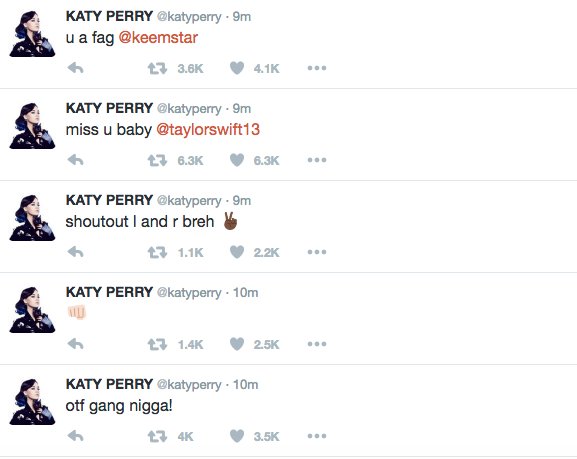
It looks like a hacker got access to pop-star Katy Perry’s Twitter account and tweeted strange messages to her 90 million followers. Included in those tweets, there was a message for Taylor Swift and other series of insults.


This morning, things turned pretty confusing for the followers of Katy Perry when her Twitter handle started tweeting suspicious tweets. As it turns out, it was the work of some notorious hacker and the tweets were soon deleted.
Notably, with 90 million followers, Katy Perry is the most followed person on the platform.
Coming back to the story of the hacking attack, the hacker seems to be using a Twitter account based in Romania that goes by the name @sw4ylol.
The hacker shared screenshots of the password reset emails sent by Twitter. The account also shared a link to a song by Katy Perry, which has been removed due to copyright violation.
In the series of bizarre tweets, there was a message for her supposed archnemesis Taylor Swift, telling that Katy Perry missed Taylor Swift.
The message for Miss Swift read, “Miss u baby @TaylorSwift13”. Another tweet read, “haha follow @sw4ylol #hackersgonnahack”.


It appears Katy Perry’s Twitter -- with her more than 89 million followers -- has been hacked…
Katy Perry isn’t the first celebrity to become a target of such attack. Selena Gomez, Ian Somerhalder, Justin Bieber, and Britney Spears are some other names in this list whose social media accounts have been compromised.
This incident once again raises questions regarding Twitter’s security measures.

Don’t forget to drop your feedback in the comments section below.

Nearly 60% of mobile gamers watch an ad or take a survey 10 times a week

More than half of highly engaged mobile games watch video ads, complete surveys, or install apps to earn virtual in-game currency rewards, according to a new study.

The most common action? Watching ads.
“Free-to-play games make money from in-app purchases or advertising. Reward-based models marry both of those and make a nice third option for the mix,” says TapResearch VP Michael Sprague. “We saw a bit of a rocky road at the beginning as ‘incentived advertising’ painted a negative image on this model, but we are now in a place that if you’re not using rewarded video, then you’re doing it wrong.”
Mobile monetization is challenging, of course, with studies consistently finding that a very low percentage of people — generally, low single digits — are willing to part with cash in exchange for games or other apps.
Why do people want virtual cash? To improve their gaming experience, of course:
why purchase virtual currency
Sprague, who was formerly with the virtual rewards platform Kiip, says that the second-most-common activity for earning virtual rewards is completing a survey, with 74 percent of respondents saying they’ve done that. (TapResearch, of course, offers mobile research monetization for app publishers, so it is not exactly a disinterested party here.)
Watching videos is clearly the leader in terms of what users prefer. When asked what their favorite activity is for earning virtual cash, 70 percent said watching a video. Probably because it requires more active involvement, less than half that number — 31 percent — say completing a survey is their favorite.
For obvious reasons, the least favorite was completing an offer, like signing up for Netflix or Amazon Prime. Few like to give away their personal information, especially their credit cards.
getting virtual cash
Sprague says that different types of apps and different kinds of user modes require different forms of monetization.
“Another interesting piece to rewarded monetization is the psychology behind it. Video is great for a quick 30-second save when users are in ‘gaming mode,'” he told me via email. “Surveys take a bit more commitment and work better when users are in ‘shopping mode.’ It all comes down to expectation setting and user choice.”
Mobile gamers want a lot of virtual currently, apparently. Sprague said that almost 60 percent of people complete 10 or more offers in an average month:
buy virtual currency
One note to remember: TapResearch surveyed just under 400 mobile users for the research. For better, more statistically significant results, 1,000 or more would have been preferable.

A Hacker Is Selling Dangerous Windows Exploit, Making All Versions Of OS Hackable

A hacker is selling a dangerous zero day vulnerability on a Russian cybercrime website. This exploit is said to be affecting more than 1.5 billion Windows users as it works on all version of Windows. The hacker wishes to sell the complete source code and demo of the exploit to any person who pays him $90,000 in bitcoin.

The underground market of malware and exploits has witnessed an exponential growth in the past few years. With the help of anonymous networks and payments in cryptocurrency, cybercriminals are easily getting access to various types of exploit kits.
In turn, this has resulted in an increased number of attacks on personal computers, enterprises, and financial institutions. These days, if a hacker is good at creating malware and exploits, he/she can make it a profession and provide services to others with low risk.
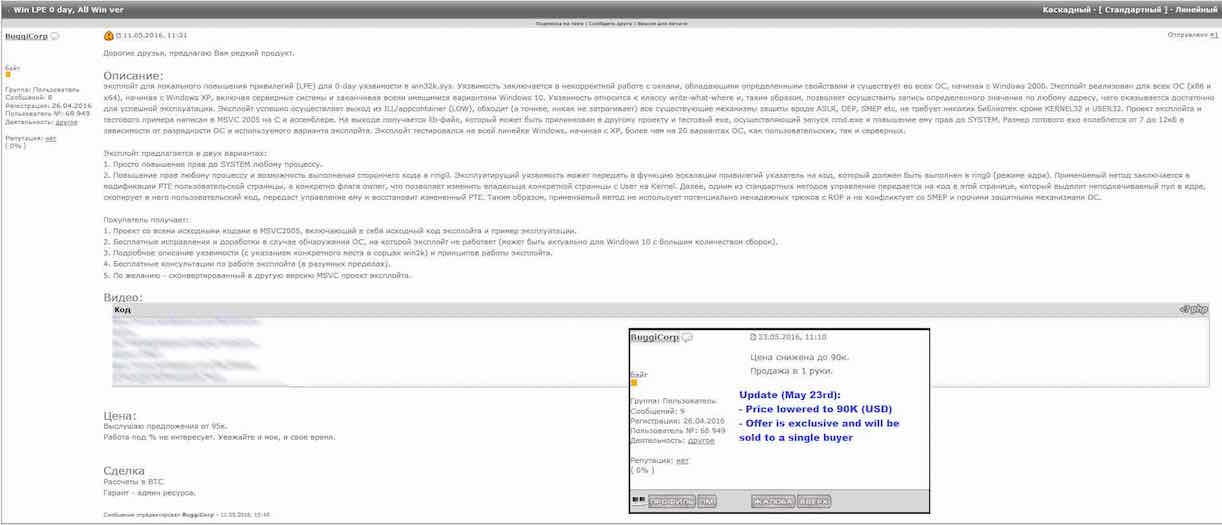
A similar case has popped up on a Russian cybercrime website. A hacker who goes by the name BuggiCorp is offering a Windows zero-day vulnerability that affects all versions of the operating system.
This listing was discovered by the security firm Trustawave, who found that the hacker was selling the exploit for $95,000. The advertisement was recently updated with a new price of $90,000.
The security firm says that while the price of exploit seems a lot, criminals are likely to make an investment due to possible high returns. zero day auction on russian website by hacker

The zero day being sold deals with Local Systems Privilege escalation

While the usual zero day exploits deal with Remote Code Execution, this zero day bug deals with a Local Systems Privilege escalation. Compared to other types of coveted malware, the privilege escalation could be used to launch any type of attack.
As expected, BuggiCorp wants the payment in Bitcoin. In his advertisements, he makes clear that the exploit works on all versions of Windows, which means that it may affect more than 1.5 billion Windows users.
He also promises to sell the exploit to a single person along with a fully-functional demo, complete exploit code, a Microsoft Visual Studio project file, and free updates for future versions of Windows.
Trustwave has notified Microsoft’s security team regarding the zero day bug and we expect some quick action.

Did you find this article interesting? Don’t forget to drop your feedback in the comments section below.

Here’s A New Programming Language That Talks To Living Cells And DNA

The genius minds at MIT have created a new system that uses a programming language to design complex DNA circuits and control the living cells. As a part of their research, MIT researchers have programmed 60 circuits with a variety of functions.

If you are willing to take a break from coding for machines, here’s a news that you might find interesting. The biological engineers at MIT have created a programming language that allows them to interact with living cells. With this language, they are able to rapidly design complex and DNA-encoded circuits to control cells.
In future, this system could be used to code a program for any desirable function. Christopher Voigt, an MIT professor of biological engineering calls it “literally a programming language for bacteria.” Just like you deal with computer programming, here, you need to take the text and compile it to create DNA sequence that could be put into the cell.
This programming language for the living cells is based on the famous Verilog system that is used to design the computer chips.
In journal Science, Researchers have explained the process of adapting the language to write the code for bacterial circuits. They wrote DNA sequences into Escherichia Coli bacteria to sense environmental conditions like oxygen, glucose, light, temperature etc.
Click to enlarge
Click to enlarge
While designing a genomic circuit — a subject that has intrigued researchers since a long time — needs a high level of skill and time, the new bacteria programming language makes things easier.
“You could be completely naive as to how any of it works,” said Prof Voigt. “That’s what’s really different about this. You could be a student in high school and go onto the web-based server and type out the program you want, and it spits back the DNA sequence.”
As a part of their research, MIT researchers programmed 60 circuits with a variety of functions. Out of these, 45 circuits worked correctly for the first time.

“It would take years to build these types of circuits,” he said. “Now you just hit the button and immediately get a DNA sequence to test.”